| |
The quality of your thinking, especially about time, determines the quality of your life
Brian Tracy |
 |
|
|
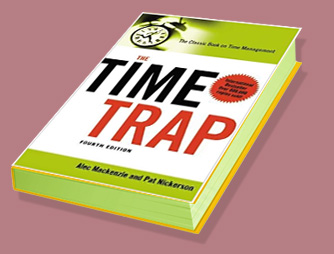
Four reasons are behind adding this book to my bookshelves
1- Alec Mackenzie was an internationally known speaker, consultant and expert on time management. Time management was like his specialty and for that he digged so deep in that area trying to cover all aspects, highlighting causes and offering solutions.
2- Focus: To be able to digest any topic that interests me thoroughly, my new strategy in reading is:
- Pick a topic, then
- Get all highly rated/bestseller books I can get my hands on
- Read/scan any article addressing the same topic |
 |
Since "Time Management" is the topic I have chosen lately, you will be hearing me talking and writing, maybe one day speaking about time management.
3- Mr. Brian Tracy: Usually book writers refer to their own other books or recommend other writers' as a kind of referral or marketing. I was reading one of Mr. Brian's books and he referred to The "Time Trap" book as a good source of information on time management.
4- To solve a problem you need to understand its main cause. I want to be better than my best in time management and to do so I will read, dive deep in the time trap world and learn new ways of getting over them.
While summarizing usually I try my best to squeeze it into two or three pages maximum, but for "Time Trap" which is more than 300 pages and which is full of traps and recovery action plans I broke this rule this time. |
|
Couple years ago, I started my reading journey focusing on business books. I was reading a book or two per year. Beginning of 2017, I changed my reading pattern and decided to put a plan, I named it "Book reading strategic plan - 2017", I prepared the list, bought the books and managed to read ten whole books which for me was a big achievement taking into consideration the complexity of my work and personal life challenges and responsibilities.
During 2017 journey, I was preparing and working on my 2018 onwards list of books and the list now has sixty six different books out of which twelve has been read so far (upto end of mid of August 2018) and another eight to ten should be finished by the end of the year.
I was taking notes, pictures by mobile camera for pages that highly inspired, attracted hit something inside me or made me feel that it can be reflected or applied in my work or personal life.Then, I decided to do what many had advised and recommended to do after reading a book:
- Try to summarize it in a page or two
- Share the lesson I personally learned from the book and post it on my website, so from now on expect a page or two (sometimes more) on every book I read.
It was page 235 that made me feel: yah, That's the one! No need to continue reading and the message you are looking for is found, it says:
"A daily plan, in writing, is the single most effective time management strategy"
|
|
|
1- Management by crisis
2- Telephone interruptions
3- Inadequate planning
4- Attempting too much
5- Drop-in visitors
6- Ineffective delegation
7- Personal disorganization
8- Lack of self-discipline
9- Inability to say no
10- Procrastination
11- Meetings
12- Paperwork
13- Leaving tasks unfinished
14- Inadequate staff
15- Socializing
16- Confused responsibility and authority
17- Poor communication
18- Inadequate controls and progress reports
19- Incomplete information
20- Travel
The top five traps are the underlined ones and I will be elaborating a little bit more about the most and biggest time trap:"Management by Crisis" |
|
Why do we still fail to see the crisis early enough to stop it? A thin trickle of minor errors and neglects, occurring systemically throughout an enterprise, can drain resources, the way a pinhole leak can weaken an underground pipe until the floor caves in. Where are the gauges and meters that should be warning us?
Avoiding crisis: Planning for prevention:
"Though you cannot say when a crisis will explode, you can uncover trickles of leak most likely to cripple your project if left untreated", you can try the following:
1- Predict possible threats (risk management)
2- Protect schedules
3- Predict standard lead times
4- Prepare simple reporting tools
5- Propel action with "insider" graphics
6- Provide key player support
7- Preserve postmortem data
|
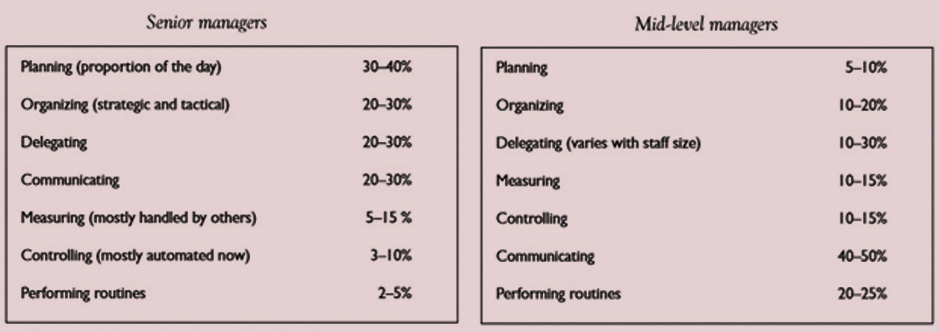
| The table below shows the way they budget their time |
 |
Give your best task your best (not earliest) time of day
Alec Mackenzie |
|
|
You cannot control other people's behavior, but you can
control your own!
Alec Mackenzie |
|
 |
Abandon the dreaded 'in' tray: each single act of noticing will drain off the focus and energy you need for the item you are actually looking for. |
|
Keep your written daily plan at eye level, on your screen or on the wall |
|
Clean up corporate papers: Most investigators estimate that only between 5 and 15 percent of files will ever be referred to after the first year. |
|
Curtail outgoing correspondence: Five suggestions
1- Prewriting
2- Avoid memos or e-mails altogether when diplomacy is at stake.
3- Be Brief
4- Ban tired endings: like do not hesitate to call with any questions, today's business people are anything but hesitant.
5- Retrieve reusable phrases |
|
|
| If you impose responsibility, you must also grant matching authority. They still rank among the top ten time wasters, with damaging effects in material, money, and morale. In some high-stakes industries they can actually endanger life.
|
Five clearing practices: to clarify responsibility and authority on any job being assigned:
1- An accurate job title
2- A written job description
3- An organization chart that shows who reports to whom
4- A written change announcement
5- A set of simple metrics to drive regular performance evaluations. |
|
It is not the interruptions that stall you; it is the
randomness of interruptions
Alec Mackenzie |
|
|
|
The five myths that stall delegation
1- I must do it myself to shield the company from mistakes
2- It is quicker to do it myself
3- I would prefer to retain tasks I enjoy
4- If I delegate, I will lose touch with the details, and with my current contacts
5- Nothing less than my level of perfection will suffice |
|
Work must be done at the lowest possible level where it can be done effectively. |
|
Ten steps to successful delegation
1-Recruit
2-Teach the task
3-Demonstrate the steps yourself
4-Elicit questions as you go
5-Let learners demo and play back
6-Do not interrupt for errors
7-Set mutual checkpoints
8-Create standard tracking methods
9-Provide access as needed
10-Assign and announce authority |
|
Two responsibilities you cannot delegate:
1-Developmental work assigned you by your boss
2-Discipline |
|
How can you tell that your D-Day (Delegation Day) has arrived?
1-When you work overtime, more often, without dramatic rewards.
2-When you leave for vacations or weekends too frazzled to focus on fun.
3-When you turn down exciting new work or miss out on new rewards because you are bogged down in stabilized routines. |
|
|
Their behavior is not deliberate or calculated, or malicious. Some procrastinators will actually blame any happening conflict on "mood"or tantrum of the unreasonable complainant.
|
Procrastintors rationalize delaying tactics with excuses, some valid, some not:
- I don't have the necessary tools or materials
- I am forced to wait for other departments to deliver the details
- There is no real rush: this demand is from someone pulling rank
- I will do it later: I work best under pressure
- The last time I hurried for this person, I got no thanks
- Others will take the credit for what I do, so why hurry?
- I never get clear instructions from on high; they are never available to clarify
- Requesters change their minds every twenty minutes. I will just wait |
|
Procrastination causes damage:
- Some people come late for meetings, and then noisily distract everyone else.
- Some put off answering e-mails and fail to return calls
- Some delay delivery on their portion of a project, dampening progress for all.
- Some withhold information, believing that knowledge is power that need not to be shared. |
|
Many are skilled at looking busy. |
|
|
|
|
|
Attempting too much: Do you make everyone happy but yourself? Unless you apply deliberate effort, you may find it hard to control your urge to overdo, embedded early in your time personality and cemented by praise from parents, friends, bosses and customers. Most likely, you will opt for theirs-and try squeezing yours in, after hours! Once you believe that everything has to be done! Now! By you!-you will have entered the trap of attempting too much. |
|
You have heard the classic rule: "If something is worth doing, it is worth doing well", we would change this to :"If something is worth doing, its worth doing as well as it deserves". |
|
Four hazardous habits of mind:
1-I needed to keep excelling, even under pressure, to keep up my sense of self-worth, but others were clearly indifferent about the results.
Escape #1:People do not work better under pressure, they work faster! And that can lead to errors, discovered too late.
2- I am reluctant to delegate, either through lack of faith in others, inadequate practice in delegating, or discomfort about my earlier, failed attempts to let go
Escape #2: Discriminate between high and low priority tasks, assign low-priority to a delegate, allow for learning and refinement time.
3-Almost daily, I overschedule myself, with unrealistic notions on how much can be done in a day.
Escape# 3: Don't assume that "it all has to be get done"-at least not by you. Prioritize and delegate or build with your team a standard lead time menu showing commonly repeated tasks.
4-Perfectionism drives me to lavish attention on minor details and to keep over reworking everything. If my name is on it, it has to be perfect or I cannot release it.
Escape# 4: Save your perfectionism for those tasks that warrant it. |
|
If you want something done, ask a busy person
Benjamin Franklin |
|
|
They come in two types:
1. The entrepreneur:
a- They work long hours
b- They love their jobs
c- They are dedicated to a "mission"
They are not workaholic at all! Though all workaholics work long hours, there are many who work long hours, without the other two motives-love of job and mission.
2. The Honest Bill Payer: fighting to stay afloat, financially, in today's economy, many workers seek significant overtime or a second job to make ends meet. The second job may start as a "Temporary measure"- but the burden often becomes permanent if conditions fail to improve.
|
|
1-Talk to HR. Rephrase the company's official statement about" Open Door"
2- Hang a Red Zone sign on you door
3-Charge a toll to anyone who ignores the Red Zone
4-Angle your desk to face the window not the door.
5-Propose a "Quiet Hour" policy for your team.
1- Simplest cure for "Slow to start; fail to finish": A daily plan, in writing, is the single most effective time management strategy.
2- There is a fine line between being an effective multi-tasker and attempting too many things ineffectively.
3- Distinguish important from urgent, once and for all |
 |
|
Whatever is mentioned in the article is purely my
personal observations and opinion.
|
 |
|
| Resources :https://en.wikipedia.org/wiki/Pareto_principle |
|